










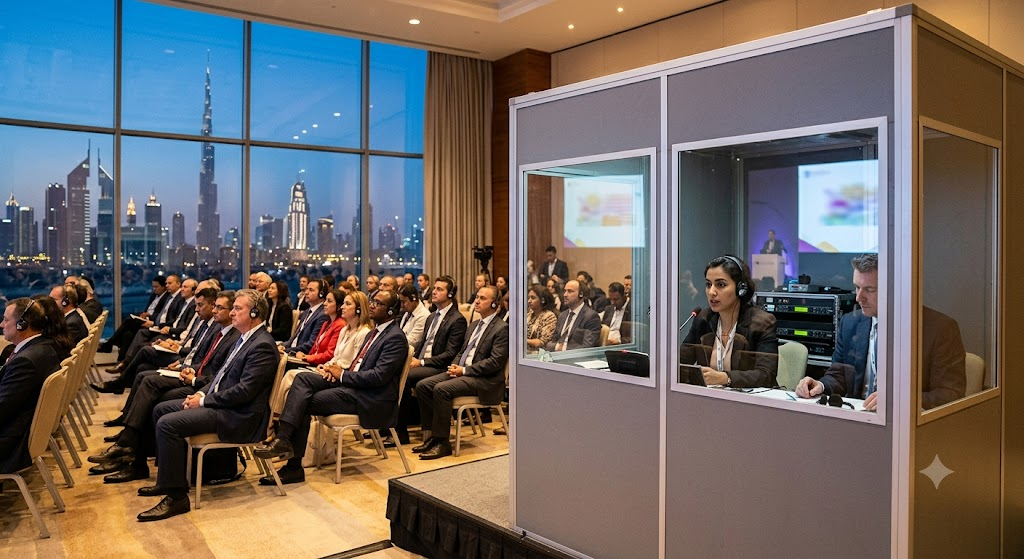
The event room looks ready at 8:30 a.m. Chairs lined up, name cards placed, microphones sitting neatly on the table. Then someone asks where the interpreter booth will go, and suddenly three people stare at the same corner as if it might explain itself. If you have ever helped with a multilingual event in Dubai, you’ll know that small silence. It comes too late.
Booking early feels boring until it saves the day
Most people remember interpretation after the venue, speakers, banners, and catering. Honestly, that order feels normal, but it also creates the mess. Interpreters need context. Technicians need room details. Someone needs to know whether the audience will use headsets or sit near a language channel screen.
The two-week mistake
A booking made two weeks before a serious conference can work, to be fair, but only if the event is simple. A single language pair. A clear agenda. Speakers who do not change their slides at midnight.
But many events are not like that.
Dubai events often pull in people from different time zones, departments, and travel schedules. If you wait until everything is “almost final,” you may discover that the interpretation setup needed decisions much earlier.
Send the messy agenda anyway
You do not need a perfect programme before asking questions. Send the rough version. Even a draft with “panel discussion, 45 minutes” tells someone more than silence.
A good interpretation request should include the event date, expected audience size, language pairs, session length, and whether speakers will be in the room or joining remotely. Weirdly enough, the remote speaker detail gets missed a lot.
The booth is not just furniture in the corner
Simultaneous interpretation feels invisible when it works. That is probably why people underestimate it. The booth, headsets, receivers, microphones, and audio feed all need to behave together — not dramatically, just reliably.
Ask about the room before you ask about price
A ballroom with 200 people is not the same as a boardroom with 18 chairs. High ceilings can affect sound. A stage position can block sightlines. Even where the coffee station sits can become annoying if people keep walking past the booth.
Before asking for Expert interpretation for global conversations, you’ll usually get a better answer if you describe the room like a real place, not just “conference hall.”
Sound checks should not be ceremonial
Some sound checks are treated like a polite ritual. Someone says “testing, testing,” everyone nods, and nothing useful happens.
Ask someone to test the actual speaking setup. Table mic. Handheld mic. Laptop audio if a video plays. The interpreter should hear what the audience hears, ideally before guests start arriving with badges and coffee.
The speaker who brings new slides
At some point, someone will bring updated slides. Maybe five minutes before their session. Maybe in another language.
Not a disaster, exactly. But if the interpreter has names, acronyms, product terms, and speaker notes earlier, the session usually feels calmer. The audience may never notice why. That is the point.
The booking details people pretend are minor
Small choices decide whether the day feels controlled or slightly wobbly. And the odd part is that these choices rarely look urgent on paper.
Language pairs are not enough
Saying “Arabic and English” is a start, not the whole thing. You may need Arabic to English, English to Arabic, or both directions. That changes planning.
For Simultaneous interpretation in dubai, you should also mention dialect concerns, sector terms, and whether the content is legal, medical, technical, financial, or just general business talk.
Count the people who will listen, not just attend
A room may have 120 attendees, but maybe only 35 need interpretation. Or maybe the opposite happens, where guests bring extra colleagues and the headset count suddenly feels too tight.
Give yourself a small buffer.
Assign one person to own the decision
Not everyone needs to manage interpretation on event day. Actually, that can make things slower. Pick one person who knows the schedule, can approve quick changes, and will answer the phone.
Simple. Slightly dull. Very useful.
The part nobody sees when it goes well
The smoothest event is not the one where nothing changes. Things always change. A speaker runs long, the moderator skips a question, someone adds a closing remark that was not in the agenda.
Good booking just makes those changes less dramatic.
You do not need to overcomplicate it. Share rough materials early, be honest about what is still uncertain, and check the room like you actually expect people to use it. The funny thing is that most last-minute problems are not mysterious. They were sitting there days earlier, looking harmless.
And maybe that is the irritating part. Interpretation gets treated as a final layer, something added once the “real” event is ready. But if people are meant to understand each other live, across languages, then it was part of the event from the start. Sort of obvious, once you have watched it go wrong.